
17. "Sister Zero"
by Dánica
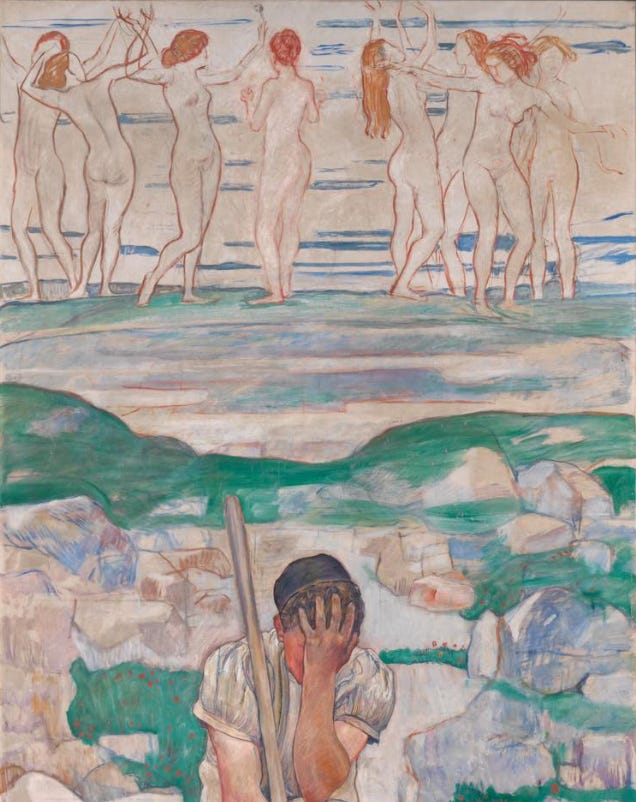
The following was transcribed from a handwritten letter addressed to Tatiana with no date, clipped onto one of the notebooks.
Tati, this is the only interesting thing that came of the six months I spent working as a temp in Marianne's firm.
It was a horrible, lonely job, though I was physically close to others the whole time. I was squeezed into a hallway lined with outdated computers and sentenced to draft inane e-mails alongside nine other interns. I was one of two girls in this group. The other girl was strange, not in an attractive way; she came off as mentally unbalanced. For some reason she was obsessed with traveling to Israel despite not being Jewish? In office jobs you meet the strangest and the worst.
Most of the fellow interns took it seriously and answered directly to a number of important men. It was amazing how their tone would shift between gross, sexual jokes and shameless sycophantry. At the end of the hall was a telephone deck from the eighties (afforded as much space as any one of us) so that any associate who wanted something—usually on a whim—could be suffered. Twice a day I would take an elevator down to the Business Center courtyard and smoke a cigarette, and stare. Usually when I returned someone would be considerate enough to tell me that the boss had called.
I didn't even try to be friendly in Marianne's firm; I wasn't going to last there and everyone knew it. They found me frigid and offputting. One or two of them mistook my aloofness for social leverage, and tried cozying up to me. But every moment was hell, Tati. I wasn't in the mood.
At 1:00 p.m. sharp I was gone. We had an hour-and-a-half lunch break. The building is tucked away into a less-notable corner of the financial district. Most of the other interns would take this time to get haircuts or sushi in the nearby Swissotel. I was spending three-fourths of my meager salary (handed via envelope on the 25th of the month) on gas to get to work in the first place. And the other fourth on alcohol. I ate in the Camino Mall.
When I talk about the mall I mean the way it was in 1998. Two years later it’d be torn down and replaced with what we have now. The old Mall was a curiosity. Despite the great location it never really worked out, I think because of a loophole in the lease contracts. What they got was a four-story labyrinth of shuttered storefronts. The few open businesses were hardly inspirational: confounding toy shops, geriatic wear, a chain pharmacy, "The World of Towels." Like Benji would say, you could smell the money being laundered.
Still the mall was a place worth exploring. There were two basement floors, and the deeper you went the further they retreated into the past. Electric stairways remained frozen, lights flickered or didn't work at all, and sunlight hardly reached the cool adobe seats arranged in semicircles. The very bottom had nothing to show except a mural that looked like it was from the sixties (with images of leaping Bengal tigers and multi-racial hand-holding), and a winding exit to the park that passes by an ATM. This was where I met the sisters, and I felt so lucky.
Tati, can you imagine meeting two nuns in the bottom floor of an abandoned mall? And they were standing directly under a fluorescent light. It felt like a revelation. In hindsight it's obvious that I felt lost and desperate at the time. I sat eating a slippery microwaved lunch, alone, mostly in the dark. To me this was a blessing, though I've never been religiously-inclined.
I would come to know the sisters as Tomasa and Giovana. They were the kind of pair you would see on a newspaper comic strip, with such exaggerated features and contrasting personalities. We made smalltalk almost immediately; they looked as relieved to find me as I was to find them. Our conversations were stilted at first, but they were happy to try. I told them that I worked nearby and they told me that they sold chocolate truffles as fundraising for the convent. They went around the neighborhood offering boxes, and had taken a moment to rest from the heat. My comments were very banal. "I couldn't imagine walking around in this heat dressed like that." But somehow the conversation was always refreshing. They did most of the work; I just sat there nodding.
(The truffles they sold were delicious. I'm sorry I never brought you any, but you might still forgive me if you keep reading.)
This went on for several days, on and off, over a couple weeks. On days when I didn't run into the sisters I usually ate alone. A couple times I went to Stephany's apartment. She was living by herself at that point, her parents were abroad. But we were never really that close, so I mostly smoked cigarettes on her balcony until it was time to go. I remember being so jealous that she was living in an apartment with a balcony overlooking Camino. Six years later I found myself in the same situation and I was miserable! I hate cute little reflections such as this one, but they are true to life regardless.
Anyway, with each of these encounters I grew closer to the sisters, and I discovered more about them. They were Franciscans, which is obvious in hindsight. The church is across from the mall, though the convent itself is quite low-profile and looks more like a parish office from the outside. Both sisters looked about middle-aged; Tomasa possibly older. Tomasa loved to guffaw, and she was gossipy. Giovana was more proper. It seemed like her partner's behavior irked her, but never to a breaking point. Always I’d dreamily assumed that any class and racial frictions between nuns would be disintegrated by their shared covenant with God, but obviously that’s not the case. Giovana also spoke about punishment. She was very much from the old school, and it was clear she didn't think much of me beyond a certain deferential tendency, which the clergy have towards worldly people when they are out on the town. And she never lost her composure. I regarded her more like a kooky aunt than a person to be feared. They seemed like ultimately likable women.
I had originally intended to spend six months or so at this job while I got my credits for graduation. But I hated university, and kept putting it off. It's easier to justify it to yourself when you're working and always exhausted. The idea of doing something productive with whatever time you can scrabble together at the end up the day seems unfeasible. Nobody wants to write application letters after six or ten hours of groveling. And that summer was miserable: ruthless and sweltering, the first summer I had to spend in pencil skirts and starchy blouses. They worked us from sunrise to sunset.
Whenever I ran into acquaintances while doing errands or grabbing lunch—especially when I ran into high school classmates—I felt rattled, almost disturbed. Partly because of the ways in which we’d changed, but also because school and everything about it now seemed like a twisted joke. The vast and unknowable world of my teens had shrunk into a roughly three-kilometer urban expanse wherein I knew every tobacco vendor. To be reminded that things used to not be that way was disheartening.
And so I began to spend more and more lunch breaks with the sisters. It was always casual and almost incidental to me. A normal person would've taken advantage of their internship to network with their peers and prove their worth to their superiors, but just the thought of it made me break out in hives. I would much rather wander the halls of a semi-abandoned shopping mall, eating tasteless and questionable salads from a Styrofoam box. At least I was alone with my thoughts. And in this way my encounters with the nuns occurred naturally. There was nowhere else nearby to hide from the sun during the deadly period between noon and 3:30, when just walking outside felt like being cooked.
Most middle-aged women eventually develop the tendency to divulge their life stories in bite-sized vignettes, and the nuns were no different. I learned that Tomasa grew up poor in the north, but had an honest and happy childhood of chasing after wild fowl, bathing in riverbanks, and crowding around black-and-white television sets with her cousins. Giovana was quite the opposite: she had been a young promise of her school's tennis club, she was very careful not to divulge embarrassing or comical childhood stories, and everything about her suggested that she was well-bred. Well, not really. I didn't believe most of what she said. For the most part it seemed like she was embarrassed of having a provincial middle-class upbringing and felt the need to put on airs around me. Perhaps she thought I was "that kind of person", simply because I worked with lawyers and executives and politicians' wives. Sometimes I thought I was "that kind of person" as well, but thankfully I snapped out of it after a few months.
It was a strange dynamic between the three of us. It took a while for me to lower my guard and not maintain an ironic distance between myself and the nuns. It was Tomasa's unbeatable enthusiasm that drew us closer. Giovana was reticent to make any personal statements, or move beyond polite conversation. (For her, polite conversation included the weather, non-political current events, and Scripture, the last of which usually drove our talks to a dead end.) We were such an unlikely group, and to be honest I would have been mortified to be caught laughing it up with them by a coworker or boss. (Nobody asked where I went for lunch; at this point everyone had correctly assumed that I despised them.) But we grew closer in spite of it all. Eventually they started bringing sweets especially for me, and I started complaining to them about my cubicle-mates. I found myself unraveling before them sometimes, going on tangents about the uselessness of higher education, the hypocrisy of office hierarchies, the fact that my job didn't seem to exist for any real purpose. In hindsight I can only assume that, gradually, I began to look a little lost to them; possibly in need of course-correction. It's no surprise that they began to find excuses to invite me into the convent. It was right there, after all.
The first time I went in I was in a daze. The convent was unsurprisingly spare, but welcoming. There was a bit of an improvised front desk where chocolate truffles slowly melted on the shelves. The living quarters were located past a heavy door that swung on its hinges instead of locking. It took a lot of convincing for me to allow the sisters to bring me, as the proposal seemed ridiculous and embarrassing. They had asked a number of times in the past and every time I had politely turned them down with reasonable excuses. As a lapsed Catholic I had my reservations about the clergy and their constant attempts at conversion. My friends, who had gone to religious schools where nuns and priests governed, had few good things to say about them: about their rigid vigilance, their glowering menace, and their penchant for corporal punishment. I could never have considered the nuns my “friends” because our lives and backgrounds were so dramatically different that I knew our relationship would never develop beyond the very specific circumstances that led us to meet in that summer. I mentally categorized them as part of a group of kooky acquaintances, which I was secretly kind of proud to have, but would be embarrassed to reveal to others.
But it was Friday, and we were allowed to leave the office early. I could have darted straight home and made plans for the beach, but instead I absentmindedly wandered into the old mall again, telling myself I was going to check out this thing or other. It was hard for me to admit that I wanted to see them, the two people with whom I had built a genuine rapport over the last couple months. I told myself those weren’t my intentions but it was blindingly obvious. And conveniently enough, there they were, fanning themselves with the lids of open chocolate boxes, readjusting their coarse and boxy habits, which I could not imagine wearing in such heat. We immediately struck up a conversation with a rehearsed kind of joviality that was so pleasant to me at the time. Tati, if there’s something to be said about nuns it’s that they know how to make people feel welcome without ever overdoing it. This little space felt so refreshing when compared to the air-conditioned nightmare of the firm. We got to talking as usual and, without realizing, I mentioned that I was free for the afternoon. The nuns were delighted and insisted that I come with them to the convent for tea. At this point I was feeling the kind of weird, warm tingles that sometimes slide down the back of your neck when you go to the hairdresser, or when a soft-spoken receptionist tends to your needs. That kind of hypnotic warmth that I associate with, I guess, service and comfort. And it almost made me want to cry. So I said yes.
Whether the nuns’ intentions were purely altruistic or there was a conversion motive, I don’t know. Maybe they saw potential in me. Who even becomes a nun in this day and age? I have to assume they’re low on numbers. But I didn’t care about any of this at the time. As soon as I accepted Tomasa and Giovana burst into a thrilled chit-chat and beamed with what seemed like genuine joy, as they probably hadn’t entertained a guest in a while. They seemed to be amused by how the sisters would react to their guest, and began to work out the logistics of the operation. I don’t know much about convents, but I’m sure nuns aren’t allowed to simply bring people from off the street. At the same time it didn’t seem like they were doing this in secret.
It’s not surprising that there was no air conditioning at the convent, or any similar amenities. Despite the background hum of comings and goings, errands and small talk, beyond the storefront was a place of monastic contemplation. I think the heat started to get to me at that point. I began to feel childlike, impressionable, and far too easy to lead. The sisters led me through a back door that opened into a wonderful little corner of the convent’s inner patio, a sunlit place with little more than an iron-legged marble table and a few, thin chairs. The arrangement looked like it had stood there unperturbed for a thousand years. It was in a walled little corner of the patio that was separated from the main square by a tight hallway, as if built in secret. The surrounding walls were covered in soothing greenery. In a moment I became aware that this was, without a doubt, Tomasa and Giovana’s secret corner, and I felt humbled. I heard the moving-around of furniture behind me and then the door closed, and immediately I began to hear baby wrens chirping in the distance. I no longer felt like I was in the city. And I began to relax, to let go in ways I hadn’t allowed myself to do for months.
It wasn’t so much that their questions were prodding or intrusive, but rather that I didn’t know how much I was supposed to divulge. The balmy afternoon and the little garden tea set were working their magic on me, but I was still sharply aware of how bizarre the situation was. And, I have to admit, part of me was also embarrassed. What would my coworkers think if they knew what I was doing with my Friday? It’s funny how I'd spent the last few months convincing myself I was above them and had no interest in their opinions, and now I was their guest. I’m not like Benji. I can’t spend my life having little “urban adventures” with aging barkeeps, lonesome street-sweepers, and cryptic record collectors. I have a reputation to uphold. Still I allowed myself to listen to their chatter instead and remained at the margins, but kept up a smile. Tomasa was once again reminiscing about her childhood in the fishing village where summers were endless and people lived in a state of what Franco would probably call “honest poverty.” Her way of telling stories was lyrical, prone to tangents which seemed to delight even her. It seemed like she never knew where exactly her anecdotes would take her, and the result was always as much of a surprise for the narrator as it was for the audience. Giovana listened with feigned interest, a kind of strained, political smile which locked her sharp features in place.
Her aimless reminiscing sputtered to a conclusion and a pleasant silence fell upon the three of us. It had probably been forty-five or so minutes since we began talking. She was wary of monopolizing the conversation even though Giovana had made no attempt to interrupt, and I was wholly someplace else. Her narration was almost therapeutic. But Giovana’s manners were stronger and she turned to me with an open gesture. She wanted to know about my day, my job and my career. My world was a bit mysterious to them; I suppose they imagined I was rubbing shoulders with “titans of finance,” and closing million-dollar deals on a daily basis with important people in high-rise buildings overlooking the skyline. To them, whose sensory life had been reduced to the convent and whatever existed in a small radius around it, there must have been some frisson to it. If only they knew how dire things really were.
I didn’t want to talk about my life and I wouldn’t have known how to do so if prompted. I tried flipping the subject back to them. I thought perhaps we had now grown close enough for me to ask more personal questions. After a bit of fluff about what it was like to work in an “important” law firm (I don’t think they were aware that a temp does nothing but data entry and espressos), I tried asking Giovana what drove her to become a nun. To this she screwed up her face for just a second (I did see it) but then it returned to a polite, tense smile. She looked above me, presumably at the sun setting behind the wall, and seemed genuinely lost in thought. Tomasa looked like an anxious child.
In so many words: Giovana lived in a small southern town, dry, quiet, and mostly populated by the elderly. Her mother was a teacher and her father occupied a certain position in the regional government. It was understood that Giovana’s family had a certain local caché which commanded respect for their forebears. (She didn’t say that, but I intuited it.) And her hometown was notable for one thing only: a beautiful, colonial church which had become a regional tourist attraction, where she had attended Mass since early childhood. All social functions of the town were, as is common, tied in some way to the parish. It was where carnivals, funerals, fundraisers, baptisms, and weddings were organized. Elegant Baroque westworks (very traditional, with little-to-no local influence), lacquered pews, a robust silver goblet for communion. Stained-glass windows dating back to the Viceroyalty. This was the most excited I ever saw Giovana, as she entered a trance state where she could access a perfect reconstruction of the building which existed in her mind. She described fussy details with remarkable ease: the wainscoting, the minor characters of the oil paintings in the priest’s quarters, the number of candles usually lit on the devotional altar. And Tomasa listened on in similar rapture, not looking directly at Giovana but rather at me, as if I were the moon reflecting her sun.
Needless to say the church had a profound impact on Giovana as a child and adolescent: it seemed to have been etched into her mind, with every stone block and artisanal flourish, forever. And she spoke of it with such obsessive adoration that at a certain point I almost felt obliged to interrupt; not because I wasn’t enjoying myself, but because I was beginning to wonder if she would get to the point of the story before sundown. She eventually caught on to this, and her face settled into her usual expression, as if she were slowly coming down from her moment of ecstasy. Then she fixed her eyes on mine and simply said this: that church burned down one day, when she was still young. It burned down completely to the ground, and while there were no casualties, the loss was immense for the town. Things were never the same, and Giovana had to leave. And she became a nun because she wanted to honor its memory. The tale ended a few minutes before sundown and they ushered me out of the building right before dark, in a flurry of gestures that had suddenly acquired a fearful and distant quality.
Tati, ten or twelve years ago, do you remember we’d all go to Salvage Beach for the summer? Our parents would rent out a place for cheap, we’d spend the summer months getting tanned to a crisp without a care in the world and so on. It was roughly two hours away from town down the old highway. Anyway, I’m asking because: do you remember ever seeing a burned-down husk of a church in the distance? Because I clearly remember it. It’s been stuck in my head since I saw it, probably at age ten or so. In fact I think that conversation brought the memory back to me. The sun was setting and I looked at this broken skeleton of a building against the sky, which was on fire. There were people moving about but for the most part it seemed abandoned. I suppose it could've been a new construction, but for some reason I always knew it was a church, and that it had burned down. Do you remember that? Am I going crazy?
The next time I ran into the sisters they were standing in exactly the same place as always, at the bottom level of the abandoned mall, on a sunbeam. This had never struck me as weird until that moment: why were they willingly placing themselves under the sunlight, in the heat of summer? In those clothes? I remember the reason why it seemed so strange to me then was because they hadn’t seen me approaching, and, as I walked toward them to say hi, I noticed that they were both staring upwards, directly at the sun’s rays, as if trying to discern something in it from the depths of that forsaken building.
My relationship with them reached its natural conclusion in the weeks that followed. We still regarded each other warmly, but my days at the firm were coming to an end and I had no reason to ever approach the mall again. I had to find work elsewhere and get my grades up, and so on. But I did visit them once more, totally out of the blue, months after this entire ordeal. I remember I had stopped at a nearby convenience store for cigarettes—I don’t remember why I was in that part of town, it was the weekend—and I caught the convent out of the corner of my eye. And I thought I should see them once more. I felt a pang of guilt for the way in which I disappeared from their lives, even if it was natural. It was just my luck that, at that precise moment, Tomasa was running the front desk. They were selling chocolate truffles, as always.
To be honest, Tati, she didn’t seem thrilled to see me. There was an immediate change in her behavior, or maybe just in her openness towards me. When she saw me come in her mouth froze into what seemed like it was about to be a scream for help. She quickly regained composure and adopted a polite coldness which was not unlike the way Giovana used to treat me. I tried making chipper small talk with her, but she didn’t bite. She talked fast and low, like our meeting was in some way illicit, and she couldn’t wait to be done with this and never see me again.
To this day I don’t really understand. Were they reprimanded for letting me into the building on that day? For shirking their duties? Did they feel silly for revealing so much of themselves to a stranger? Did they feel resentful and abandoned? I guess it could be any or all of those things.
I did ask her about Giovana, and she said she was just beyond the doors, sweeping the halls which led to the nuns’ quarters. I guess I was way out of bounds here, but at the time I didn’t give it a second thought: I had every intention of saying hello, and so I walked past Tomasa and swung the heavy door open, peering into the tiled halls which led beyond the front desk and into a bowels of the convent, where visitors were not allowed. I didn’t even intend to walk in! I just wanted to see her, and wave, and that would be that. And maybe I would’ve bought some chocolates as a sign of goodwill. Anyway, there wasn’t anyone on the other side, but I did see a bucket of water set down, as if someone had abandoned their work partway through. Was Giovana avoiding me? Had she been listening to our conversation? I couldn’t find out because Tomasa immediately seized me by the arm with intention to cause pain, and I was bewildered, stepping back and letting the door swing back on its hinges, almost hitting me in the face. I was being fiercely reprimanded: she was saying something about how it was strictly prohibited for visitors to look into the private quarters, and that Giovana was busy anyway, and then something about nuns’ vows, and so on. I was too rattled to listen. I allowed her to lead me back towards the entrance, hand firmly on my bicep like an exasperated schoolteacher with a petulant child, and with that we said our goodbyes. I was in a daze. I felt so violently rejected that I didn’t dare protest or inquire.
That’s the end of the story. I know you’ve never been there, Tati, and I don’t recommend visiting. After the other things I’ve learned from your friends, it’s clear that something’s going on there. Also, I did a little amateur web-searching and I can’t find the church that burned down? I imagine there would be at least a few news stories about it, but nothing matches the timeframe and location described. But I do remember seeing something like that on drives home from the beach, do you? Is it possible Giovana was embellishing the story, and this was some dinky chapel in the middle of nowhere? Or am I connecting dots that don’t exist?
Note: The following is a typewritten page pasted onto the notebook which seems to serve as a follow-up to this entry. It’s a copy of a short essay called “Rotten Sun” by Georges Bataille. An official English translation is used here. The relevant fragment is included.
The sun, from the human point of view (in other words, as it is confused with the notion of noon) is the most elevated conception. It is also the most abstract object, since it is impossible to look at it fixedly at that time of day. If we describe the notion of the sun in the mind of one whose weak eyes compel him to emasculate it, that sun must be said to have the poetic meaning of mathematical serenity and spiritual elevation. If on the other hand one obstinately focuses on it, a certain madness is implied, and the notion changes meaning because it is no longer production that appears in light, but refuse or combustion, adequately expressed by the horror emanating from a brilliant arc lamp. In practice the scrutinized sun can be identified with a mental ejaculation, foam on the lips, and an epileptic crisis. In the same way that the preceding sun (the one not looked at) is perfectly beautiful, the one that is scrutinized can be considered horribly ugly. In mythology, the scrutinized sun is identified with a man who slays a bull (Mithra), with a vulture that eats the liver (Prometheus): in other words, with the man who looks along with the slain bull or the eaten liver. The Mithraic cult of the sun led to a very widespread religious practice: people stripped in a kind of pit that was covered with a wooden scaffold, on which a priest sliced the throat of a bull; thus they were suddenly doused with hot blood, to the accompainment of the bull’s boisterous struggle and bellowing—a simple way of reaping the moral benefits of the blinding sun. Of course the bull himself is also an image of the sun, but only with his throat slit. The same goes for the cock, whose horrible and particularly solar cry always approximates the screams of slaughter. One might add that the sun has also been mythologically expressed by a man slashing his own throat, as well as by an anthropomorphic being deprived of a head. All this leads one to say that the summit of elevation is in practice confused with a sudden fall of unheard-of violence. The myth of Icarus is particularly expressive from this point of view: it clearly splits the sun in two—the one that was shining at the moment of Icarus’s elevation, and the one that melted the wax, causing failure and a screaming fall when Icarus got too close. […]
Note: Upon removing this page from the notebook, the following handwritten note was discovered on the back:
I saw her. She reached out her arms between the iron bars of the second-storey window. I don’t know what she was doing. I instantly knew it was her. Her sleeves left her wrists and hands uncovered. She had been burned severely. She was nothing but mottled flesh and scabs.
This one was absolutely fantastic, and the ambiance and the strangeness of everything has me mesmerized. Absolutely fantastic, the “rotten sun” extract makes it all the more deightfully intriguing. I wonder who went into jail? I remember K getting in trouble with heaters at school….